

Comparison
CyberPower CP1500PFCLCD vs APC BE600M1
Which Router Backup Should You Buy?
CyberPower CP1500PFCLCD or APC BE600M1 for a router, modem or NAS? Compare capacity, outlets, waveform, runtime curves and USB shutdown support before buying.
By thisPING EditorialUpdated November 5, 202612 min read2 picks
On this page · Our picks at a glance
Our picks at a glance
- 1
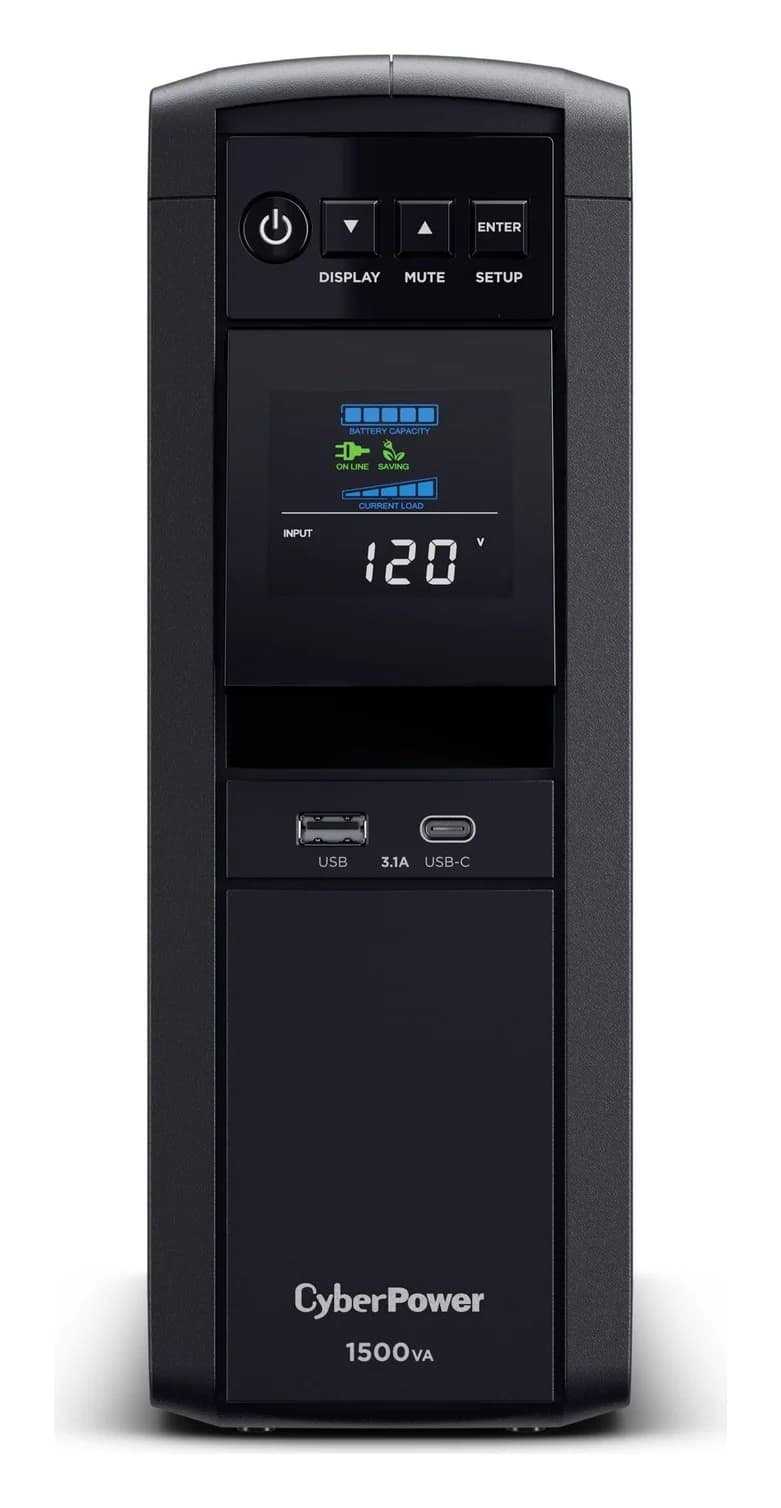
Best for a NAS and network stack
Choose for: Best for a NAS and network stack
Check before buying: it is a large, heavy box that needs floor or desk space — the BE600M1 can hang on a wall, this cannot.
- 2
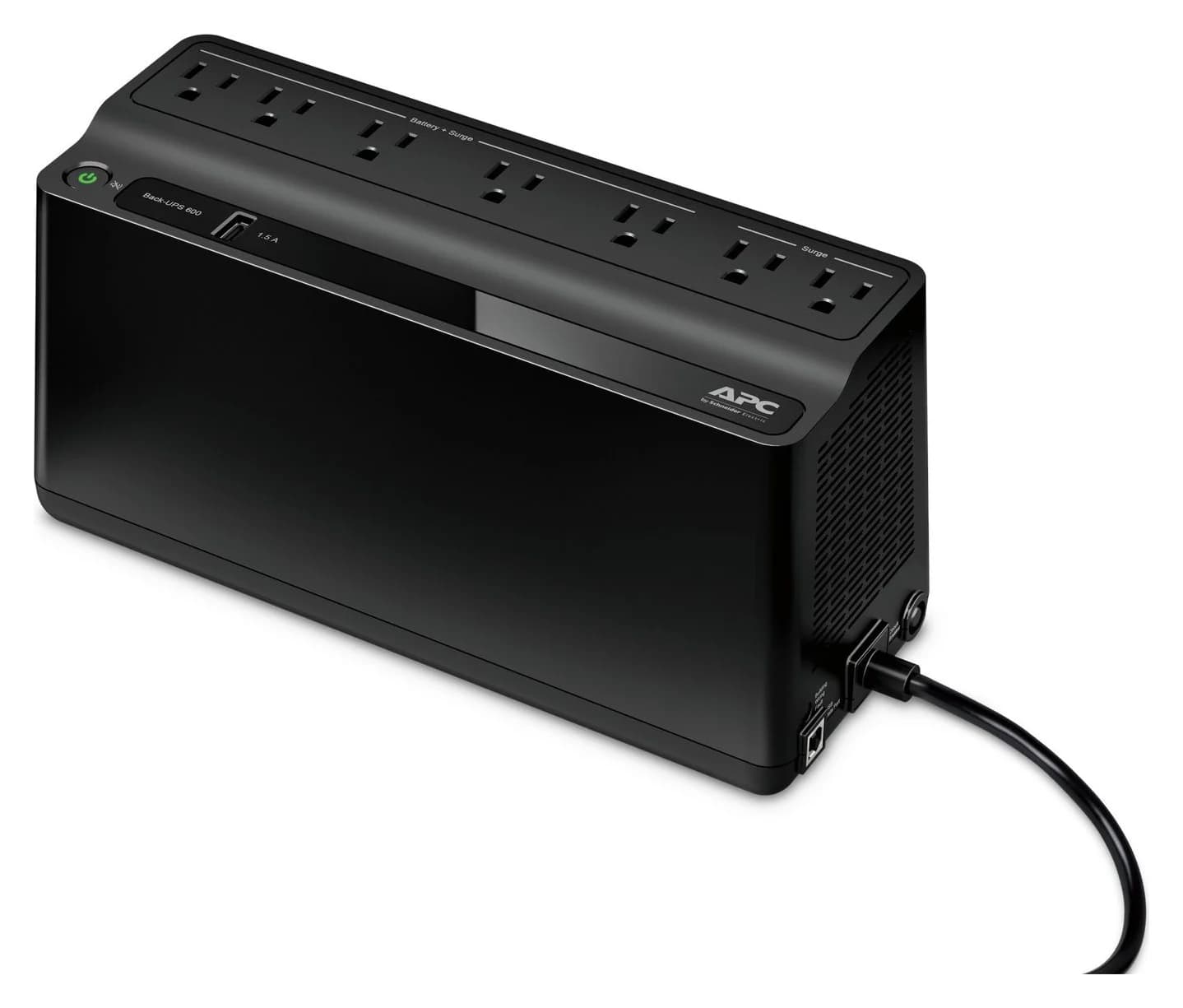
Best small backup for a router and modem
Choose for: Best small backup for a router and modem
Check before buying: Standby topology with a stepped sine wave output; some active PFC power supplies may not run well on it
For keeping a router and modem online through outages, the APC Back-UPS BE600M1 is the right size: five battery-backed outlets, a compact floor- or wall-mount case, and a documented USB data port in a 600 VA / 330 W standby unit. Buy the CyberPower CP1500PFCLCD instead when a NAS, a PoE switch or a full network stack is in play: 1500 VA / 1000 W of sine-wave capacity, automatic voltage regulation, six battery-backed outlets and a HID-compliant USB monitoring port. The difference that matters is load and shutdown: below roughly 330 W with no NAS, the BE600M1 wins on size and simplicity; above it, or with a NAS that must shut down cleanly, the CP1500PFCLCD is the pick. All specifications checked against CyberPower's and Schneider Electric's own pages and manuals, November 4, 2026.
Quick picks
- Buy the BE600M1 for a router, modem and a modest network. Five battery-backed outlets and a wall-mount option suit a small essentials-only setup.
- Buy the CP1500PFCLCD for a NAS, homelab or network rack. Sine-wave output, AVR and triple the watt capacity carry bigger loads and active-PFC power supplies.
- Buy neither if your stack exceeds 1000 W or you need network-wide SNMP management without adding an optional card — see "When neither UPS is enough" below.
Both are US 120 V models with NEMA 5-15 plugs; check the regional variant pages before buying outside North America.
Compare the hardware first
Capacity
- CyberPower CP1500PFCLCD
- 1500 VA / 1000 W
- APC BE600M1
- 600 VA / 330 W
Topology
- CyberPower CP1500PFCLCD
- Line interactive
- APC BE600M1
- Standby
Waveform on battery
- CyberPower CP1500PFCLCD
- Sine wave
- APC BE600M1
- Stepped approximation to a sine wave
Battery-backed outlets
- CyberPower CP1500PFCLCD
- 6 NEMA 5-15R
- APC BE600M1
- 5 NEMA 5-15R
Surge-only outlets
- CyberPower CP1500PFCLCD
- 6
- APC BE600M1
- 2
Automatic voltage regulation
- CyberPower CP1500PFCLCD
- Yes (single boost)
- APC BE600M1
- No
Runtime at full load
- CyberPower CP1500PFCLCD
- 2.5 min
- APC BE600M1
- 3min 12s
Typical transfer time
- CyberPower CP1500PFCLCD
- 4 ms
- APC BE600M1
- 6 ms typical, 10 ms maximum
USB data port
- CyberPower CP1500PFCLCD
- Yes (HID-compliant)
- APC BE600M1
- Yes (separate data port; PowerChute, Windows)
USB charging
- CyberPower CP1500PFCLCD
- 2 ports (Type-A + Type-C, 3.1 A shared)
- APC BE600M1
- 1 Type-A port, 1.5 A
Replacement battery
- CyberPower CP1500PFCLCD
- RB1290X2 or RB1280X2B (by serial prefix)
- APC BE600M1
- APCRBC154
Warranty
- CyberPower CP1500PFCLCD
- 3 years, including batteries
- APC BE600M1
- 3 years
Full comparison table
Swipe to compare. Row labels stay visible.
| Official specification | CyberPower CP1500PFCLCD | APC BE600M1 |
|---|---|---|
| Capacity | 1500 VA / 1000 W | 600 VA / 330 W |
| Topology | Line interactive | Standby |
| Waveform on battery | Sine wave | Stepped approximation to a sine wave |
| Battery-backed outlets | 6 NEMA 5-15R | 5 NEMA 5-15R |
| Surge-only outlets | 6 | 2 |
| Automatic voltage regulation | Yes (single boost) | No |
| Runtime at full load | 2.5 min | 3min 12s |
| Typical transfer time | 4 ms | 6 ms typical, 10 ms maximum |
| USB data port | Yes (HID-compliant) | Yes (separate data port; PowerChute, Windows) |
| USB charging | 2 ports (Type-A + Type-C, 3.1 A shared) | 1 Type-A port, 1.5 A |
| Replacement battery | RB1290X2 or RB1280X2B (by serial prefix) | APCRBC154 |
| Warranty | 3 years, including batteries | 3 years |
Scroll horizontally to see every column
| Official specification | CyberPower CP1500PFCLCD | APC BE600M1 |
|---|---|---|
| Capacity | 1500 VA / 1000 W | 600 VA / 330 W |
| Topology | Line interactive | Standby |
| Waveform on battery | Sine wave | Stepped approximation to a sine wave |
| Battery-backed outlets | 6 NEMA 5-15R | 5 NEMA 5-15R |
| Surge-only outlets | 6 | 2 |
| Automatic voltage regulation | Yes (single boost) | No |
| Runtime at full load | 2.5 min | 3min 12s |
| Typical transfer time | 4 ms | 6 ms typical, 10 ms maximum |
| USB data port | Yes (HID-compliant) | Yes (separate data port; PowerChute, Windows) |
| USB charging | 2 ports (Type-A + Type-C, 3.1 A shared) | 1 Type-A port, 1.5 A |
| Replacement battery | RB1290X2 or RB1280X2B (by serial prefix) | APCRBC154 |
| Warranty | 3 years, including batteries | 3 years |
Sources: CyberPower's CP1500PFCLCD product page and APC's official US product page.
Three rows decide most purchases. Capacity caps what you can plug in: 330 W covers a modem, router and a small switch; 1000 W absorbs a NAS, a PoE switch and accessories with headroom. Waveform matters for the load's power supply: the CP1500PFCLCD's manual says it supports active-PFC power supplies, while APC's manual warns some equipment may not accept a stepped waveform. Runtime at full load is not the number to shop on — a router load is far below full load, so read the curve section below instead.
- 1000 WCP1500PFCLCD continuous output
- 330 WBE600M1 continuous output
- 6 and 5Battery-backed outlets (CP1500PFCLCD and BE600M1)
- 3 min 12 sBE600M1 runtime at full (330 W) load
Best for a NAS and network stack: CyberPower CP1500PFCLCD
The CP1500PFCLCD is a line-interactive mini-tower with sine-wave battery output. CyberPower lists 1500 VA / 1000 W, twelve NEMA 5-15R outlets (six battery-backed, six surge-only), AVR to correct minor fluctuations without draining the battery, and a HID-compliant USB port for monitoring and shutdown. PowerPanel Business software is a free download for Windows, macOS and Linux, and an optional RMCARD205 adds SNMP/HTTP remote management over the network.
- Sine-wave output on battery; the manual states it supports active-PFC power supplies
- Two internal 12 V / 9 Ah sealed lead-acid batteries; typical recharge 8 hours
- Color LCD panel (tilts up to 22 degrees) showing input voltage, output voltage and estimated run time
- 1445 J of surge suppression; an RJ45 1-in/1-out network protection path rated for 10/100/1000 Ethernet with PoE compatibility
- 24.9-pound mini-tower, 3.9 x 11.0 x 14.0 (in), with two widely spaced outlets for power bricks
- 3-year warranty including batteries, backed by a Connected Equipment Guarantee
{{product:}}
The trade-offs: it is a large, heavy box that needs floor or desk space — the BE600M1 can hang on a wall, this cannot. Battery replacement depends on the serial-number prefix (RB1290X2 for serials beginning CXX; RB1280X2B for CR9, CXF or CQC), so keep that straight when the time comes. Its RJ45 surge path is a gigabit path, so multi-gig links should stay cabled directly between devices. And CyberPower's own FAQ warns that a load kept high shortens battery life — the manual recommends keeping the load below 80% of rated capacity for best performance.
Check the exact CP1500PFCLCD configuration at CyberPower.
Best small backup for a router and modem: APC BE600M1
The BE600M1 is a standby UPS: it passes utility power through and switches to battery when voltage drops or an over-voltage transfer condition occurs; APC's manual lists a 139 Vac typical over-voltage transfer. APC describes it as designed to power wireless home networking devices (router and modem) for hours during utility outages. Its seven outlets split into five battery-backed plus surge, and two surge-only; the surge energy rating is 490 J.
- 600 VA / 330 W capacity; transfer time 6ms typical, 10ms maximum
- USB data port for PowerChute Personal Edition, plus a separate 1.5 A Type-A charging port that works on utility and battery power
- Floor or wall mounting using two keyhole sockets on the side
- User-replaceable APCRBC154 battery cartridge; 10-hour typical recharge
- 7.7 lb at 10.8 in x 4.1 in x 5.5 in — small enough for a shelf or wall near the gateway
- 3-year warranty and an equipment protection policy for connected gear
{{product:}}
The trade-offs: 330 W is a hard ceiling, so a NAS plus a PoE switch can exceed it on its own. The battery waveform is a stepped approximation to a sine wave; APC's manual explicitly lists "connected equipment does not accept the step-approximated sine waveform" as a troubleshooting symptom and provides a sensitivity setting (LOW 88–142 Vac, MEDIUM 92–139 Vac, HIGH 96–136 Vac) for equipment sensitive to voltage and waveform fluctuations. PowerChute Personal Edition is Windows-only — APC's own note says to use the native shutdown feature on macOS. And the closely named BN650M1, sold in the same manual family, lacks the USB data port entirely, so buy by the exact model code if NAS shutdown might be in your future.
Check the exact BE600M1 configuration at APC / Schneider Electric.
Model and version traps
Both makers sell sibling models that look identical in a listing but differ where it counts.
- CyberPower CP1500PFCLCD vs the PFC Sinewave series: CyberPower's series table lists the CP850PFCLCD (850 VA / 510 W, 10 outlets), CP1000PFCLCD (1000 VA / 600 W, 10 outlets) and CP1350PFCLCD (1350 VA / 880 W, 12 outlets) with the same sine-wave line-interactive design and mini-tower format. The CP1500PFCLCD's 1000 W output is what separates it from its mini-tower siblings.
- APC BE600M1 vs its manual siblings: the shared manual covers BE600M1/BE600M1-LM (600 VA, 330 W), BN650M1/BN650M1-CA (650 VA, 360 W) and BE670M1/BN675M1 (675 VA, 360 W). The USB data port is available on the BE600M1, BE600M1-LM, BN650M1-CA, BE670M1 and BN675M1 — but not the BN650M1. All use the same APCRBC154 replacement battery.
Which load do you actually have?
List every powered box
Modem or ONT, router, any required switch, the NAS, remote mesh nodes — each with its own AC adapter.
Measure AC watts, not PSU ratings
A power supply's rated output is not its AC consumption; measure with the network doing its normal work, PoE devices included.
Add headroom
CyberPower's manual recommends keeping the load below 80% of rated capacity, so a 1000 W unit is sized for an 800 W-class load at most.
Check the curve at your total
Read the maker's runtime curve at your measured load — full-load figures are the worst case, not the router case.
A representative stack — modem, router, an 8-port PoE switch and a two-bay NAS — typically lands near the 50–100 W curve points above, which both units can carry. The BE600M1's 330 W limit is only reached when you add a bigger NAS, a desktop-class server, or several PoE cameras on top; that is exactly where the CP1500PFCLCD's 1000 W ceiling and six backed outlets start earning their keep. Our UPS picks for router and NAS guide walks the load worksheet in more detail, and the best NAS for home guide covers the storage side of the equation.
Runtime: read the curve, not the box
CyberPower publishes a load-specific runtime curve for the CP1500PFCLCD. The maker qualifies it as based on testing fully-charged, new batteries at normal operating conditions, and approximate — battery age, charge level and environment all change the result.
Source: CyberPower manufacturer curve data; approximate, new fully charged batteries
At a typical 50–100 W network load, the CP1500PFCLCD's published points sit near 66–100 minutes — enough for most short outages, with the NAS set to shut down well before the battery empties. APC does not publish a comparable curve table for the BE600M1; its specifications cover loads from 33 to 330 W, with 3min 12s at full load. For a small router-and-modem load, expect substantially longer than the full-load figure, and confirm on APC's runtime widget before committing to an outage-duration goal.
NAS shutdown: USB, software and Standby Mode
A UPS protects data in two stages: battery time while the power is out, then a clean shutdown before the battery empties. For Synology NAS, the DSM operating system supports USB UPS devices directly: connect the UPS's USB data port to the NAS, enable UPS support in Control Panel → Hardware & Power → UPS, and the NAS enters Standby Mode — Synology describes Standby Mode as stopping all services and unmounting volumes to prevent data loss. By default the NAS waits until the UPS reports a low battery.
- The CP1500PFCLCD's HID-compliant USB port is a candidate connection for this. Verify that the exact NAS or OS detects this UPS before relying on unattended shutdown. CyberPower's PowerPanel Business adds agent-based shutdown for Windows, macOS, Linux and VMware hosts.
- The BE600M1's data port is documented for PowerChute Personal Edition, which APC notes is only compatible with a Windows operating system. A NAS or macOS machine needs the NAS's or OS's own USB UPS support instead.
- Synology also supports SNMP UPS devices; on the CP1500PFCLCD that requires the optional RMCARD205 card, and the BE600M1 has no network management option at all.
- Yes: Synology or other NAS with USB HID UPS support: either UPS's data port is a candidate
- Yes: Windows PC shutdown: CP1500PFCLCD (PowerPanel Business) or BE600M1 (PowerChute Personal Edition)
- Partly: macOS: the CP1500PFCLCD's PowerPanel Business supports macOS 12 through 15.2; for the BE600M1, APC's note is to use the macOS native shutdown feature
- No: The USB charging ports on either unit carry no shutdown signal
- No: No SNMP network shutdown on either unit as sold (CP1500PFCLCD needs the optional RMCARD205)
One shared-UPS trap deserves a flag: if the NAS and the router share the CP1500PFCLCD, check the NAS's UPS setting that shuts the UPS itself down after Standby Mode — turning the UPS's battery output off takes the router and modem down with it. Synology documents UPS power-off support as varying by NAS model.
Placement, heat and battery care
Both units are sealed lead-acid designs with 32 to 104 °F (0 to 40 °C), 0–95% non-condensing humidity, and 0 to 10,000 ft elevation; CyberPower specifies 0–3,048 m and APC specifies 0–3,000 m. Keep vents clear, keep them out of direct sunlight, and expect battery life to fall with discharge cycles and heat. APC lists a 3–5 year average battery life. The CP1500PFCLCD's batteries are not hot-swappable, but are user-replaceable; the same is true of the BE600M1's APCRBC154 cartridge. Both charge while plugged in whether switched on or off, and both need an initial charge after unpacking — 24 hours for the BE600M1 per its manual, and CyberPower recommends at least 8 hours before first use. The CP1500PFCLCD carries the maker's energy-efficiency certification for UPS systems and uses a GreenPower UPS bypass design that CyberPower says reduces energy consumption, noise and heat buildup when AC power is stable.
Size is the practical difference: the CP1500PFCLCD is a 24.9-pound mini-tower that wants floor or shelf space beside the rack; the BE600M1 at 7.7 lb can sit on a shelf or hang on a wall by its keyhole sockets — useful when the gateway lives in a closet.
How we choose
We have not tested either unit. Every specification here comes from CyberPower's official product page and manual, and from Schneider Electric's official US store page and the shared APC Back-UPS manual, all checked November 4, 2026; NAS shutdown behavior comes from Synology's DSM documentation. We compare capacity, waveform, backed-outlet count, documented runtime curves and the shutdown data path, and we flag every sibling-model trap we can verify. Full method: How we choose.
When neither UPS is enough
Neither model handles every network. Move up when:
- Your stack exceeds 1000 W. CyberPower's series table lists the OR2200PFCRT2U (2000 VA / 1540 W) for rack installations, and APC's Smart-UPS line sits above Back-UPS entirely.
- You need the UPS itself on the network. The CP1500PFCLCD supports SNMP/HTTP monitoring only with the optional RMCARD205 card; the BE600M1 has no remote management. A NAS-only network can use the NAS as a network UPS server for other clients instead.
- You need multi-gig surge protection inline. Both RJ45 paths are gigabit-class; route 2.5G or 10G links around the UPS's data ports, or protect them upstream. Our multi-gig switches guide covers the switching side.
- Your gear is not US 120 V. Both are NEMA 5-15, 120 V models; buy the regional variant instead of adapting.
Verdict
Buy the APC BE600M1 when the job is keeping a modem, router and a couple of small boxes alive through an outage: it is compact, wall-mountable, and APC designs it exactly for that job. Buy the CyberPower CP1500PFCLCD when a NAS, a PoE switch or a heavier stack is in play, when your equipment needs sine-wave output or active-PFC support, or when six battery-backed outlets and a HID USB shutdown path are what the network needs. In between, let the measured wattage decide: under 330 W with no NAS, the BE600M1; over it, the CP1500PFCLCD. Whatever you pick, verify the shutdown path on your exact NAS and read the runtime curve at your real load before the next storm.
Frequently asked questions
Which is better for a router and modem: CP1500PFCLCD or BE600M1?
The BE600M1 fits a plain router-and-modem pair: APC describes it as designed to power wireless home networking devices (router and modem) during outages, and five battery-backed outlets cover a modem, router, a switch and a small accessory or two. Buy the CP1500PFCLCD when a NAS, PoE switch or a bigger stack of boxes raises the load above roughly 330 W, when you want sine-wave output for an active-PFC power supply, or when six battery-backed outlets are not enough.
How long will each UPS run a router and modem?
It depends on the total connected load, and makers publish load-specific curves rather than a single figure. CyberPower's CP1500PFCLCD curve lists approximately 100 minutes at 50 watts, 66 minutes at 100 W and 14 minutes at 400 W for new, fully charged batteries. APC's BE600M1 specifications cover loads from 33 to 330 W. At full load CyberPower lists 2.5 min and APC lists 3min 12s. Measure your actual AC draw and read the exact curve.
Can either UPS shut down a NAS safely over USB?
Both have a USB data path, but neither is certified for every NAS by that fact alone. The CP1500PFCLCD lists a HID-compliant USB port with PowerPanel Business software; the BE600M1's manual documents a separate USB data port used by PowerChute Personal Edition, which is Windows-only. Synology DSM supports USB UPS devices directly and puts the NAS into Standby Mode, stopping services and unmounting volumes. Verify your exact NAS detects the UPS before relying on unattended shutdown.
Does a stepped sine wave harm a router or NAS power supply?
APC's own manual says connected equipment may not accept the BE600M1's step-approximated sine waveform and lists a sensitivity setting for equipment that is sensitive to voltage and waveform fluctuations. The CP1500PFCLCD outputs a sine wave on battery and its manual states it supports power supplies with Active PFC. If your NAS or PC uses an active-PFC power supply, sine wave is the safer documented choice.
Related guides
Comparison · Cables & Accessories
Keystone vs Punch-Down Patch Panels: Choose a Complete Kit
Choose a keystone or punch-down patch panel that fits your cable and rack, with jack dimensions, tool choices, and complete 12- and 24-port shopping lists.
Comparison · Cables & Accessories
Ethernet vs Wi-Fi: Choose for Your PC, Console, TV or NAS
Choose Ethernet or Wi-Fi by device, ports and cable access. Find the smallest useful upgrade for gaming, calls, streaming and NAS transfers, then verify it.
Best picks · Cables & Accessories
Battery Backup for a Router and NAS: UPS Picks That Fit
Choose a battery backup for your router and NAS by load, outlets and shutdown support. Compare APC and CyberPower, check runtime, and wire every needed box.