

Comparison
GL.iNet Beryl 7 vs ASUS RT-BE58 Go
Which Travel Router Should You Buy?
Pick between the GL.iNet Beryl 7 and ASUS RT-BE58 Go by ports, power, tethering, captive portals and VPN speed. Specs from the makers.
By thisPING EditorialUpdated November 5, 20268 min read
On this page · Quick picks
GL.iNet Beryl 7 is the better pick for most travelers: it puts 2.5 Gbps Ethernet on both its WAN and LAN ports, accepts USB-C PD power from a power bank, and its maker publishes WireGuard speeds up to 1,100 Mbps. Choose the ASUS RT-BE58 Go if you already run ASUS gear at home or want 4G/5G phone tethering and WISP public-Wi-Fi mode in the same palm-sized box. Everything here is desk research from the two makers' official pages; we have not tested either device. (GL.iNet Beryl 7, ASUS RT-BE58 Go)
Checked November 2026 against both makers' published specifications.
Quick picks
- Hotel Ethernet, phone tethering, VPN-heavy use: pick Beryl 7. Dual 2.5 Gbps ports and the higher published VPN ceilings suit it to work trips and remote access.
- Public Wi-Fi, cruise-adjacent travel, ASUS home network: pick RT-BE58 Go. WISP mode, 4G/5G tethering and AiMesh node support cover scenarios Beryl 7 approaches differently.
- Gift for a frequent traveler: either works; see the travel-kit checklist below, because the router alone is never the whole gift.
For a wider field including other Wi-Fi 7 travel routers, see our best travel routers guide, and our best Wi-Fi 7 routers roundup for desk-bound models.
Beryl 7 vs RT-BE58 Go: the comparison table
These are manufacturer specifications, not measured results. The Wi-Fi class on both is a summed theoretical figure, not a promised download speed, and neither router has a 6 GHz radio.
Exact model
- GL.iNet Beryl 7
- GL-MT3600BE
- ASUS RT-BE58 Go
- RT-BE58 Go
Wi-Fi
- GL.iNet Beryl 7
- Dual-band Wi-Fi 7: 2.4 and 5 GHz
- ASUS RT-BE58 Go
- Dual-band Wi-Fi 7: 2.4 and 5 GHz
Summed theoretical class
- GL.iNet Beryl 7
- 688 + 2,882 Mbps (BE3600)
- ASUS RT-BE58 Go
- 688 + 2,882 Mbps (BE3600)
Ethernet
- GL.iNet Beryl 7
- 2.5 Gbps WAN + 2.5 Gbps LAN
- ASUS RT-BE58 Go
- 2.5 Gbps WAN + 1 Gbps LAN
USB data port
- GL.iNet Beryl 7
- USB 3.0 Type-A
- ASUS RT-BE58 Go
- USB 3.0 Type-A
Phone tethering
- GL.iNet Beryl 7
- USB tethering, USB cellular modem
- ASUS RT-BE58 Go
- USB tethering, 4G LTE and 5G mobile tethering
Power input
- GL.iNet Beryl 7
- USB-C PD: 5V/3A, 9V/3A, 12V/2.5A
- ASUS RT-BE58 Go
- USB-C PD (18W per product page); spec sheet lists a 12V/2A or 9V/2A supply
Memory
- GL.iNet Beryl 7
- 512MB DDR4 RAM, 512MB flash
- ASUS RT-BE58 Go
- 1GB DDR4 RAM, 256MB flash
CPU
- GL.iNet Beryl 7
- MediaTek quad-core at 2.0 GHz
- ASUS RT-BE58 Go
- 2.0 GHz quad-core
Router size and weight
- GL.iNet Beryl 7
- 120 x 83 x 34 mm, 205 g
- ASUS RT-BE58 Go
- 99 x 111 x 36 mm, 232 g
Maker's VPN ceiling
- GL.iNet Beryl 7
- WireGuard 1,100 Mbps; OpenVPN-DCO 1,000 Mbps
- ASUS RT-BE58 Go
- WireGuard 300 Mbps; OpenVPN 150 Mbps
Mesh story
- GL.iNet Beryl 7
- GL.iNet's own repeater features
- ASUS RT-BE58 Go
- AiMesh node or primary router with ASUS models
Full comparison table
Swipe to compare. Row labels stay visible.
| What changes your decision | GL.iNet Beryl 7 | ASUS RT-BE58 Go |
|---|---|---|
| Exact model | GL-MT3600BE | RT-BE58 Go |
| Wi-Fi | Dual-band Wi-Fi 7: 2.4 and 5 GHz | Dual-band Wi-Fi 7: 2.4 and 5 GHz |
| Summed theoretical class | 688 + 2,882 Mbps (BE3600) | 688 + 2,882 Mbps (BE3600) |
| Ethernet | 2.5 Gbps WAN + 2.5 Gbps LAN | 2.5 Gbps WAN + 1 Gbps LAN |
| USB data port | USB 3.0 Type-A | USB 3.0 Type-A |
| Phone tethering | USB tethering, USB cellular modem | USB tethering, 4G LTE and 5G mobile tethering |
| Power input | USB-C PD: 5V/3A, 9V/3A, 12V/2.5A | USB-C PD (18W per product page); spec sheet lists a 12V/2A or 9V/2A supply |
| Memory | 512MB DDR4 RAM, 512MB flash | 1GB DDR4 RAM, 256MB flash |
| CPU | MediaTek quad-core at 2.0 GHz | 2.0 GHz quad-core |
| Router size and weight | 120 x 83 x 34 mm, 205 g | 99 x 111 x 36 mm, 232 g |
| Maker's VPN ceiling | WireGuard 1,100 Mbps; OpenVPN-DCO 1,000 Mbps | WireGuard 300 Mbps; OpenVPN 150 Mbps |
| Mesh story | GL.iNet's own repeater features | AiMesh node or primary router with ASUS models |
Scroll horizontally to see every column
| What changes your decision | GL.iNet Beryl 7 | ASUS RT-BE58 Go |
|---|---|---|
| Exact model | GL-MT3600BE | RT-BE58 Go |
| Wi-Fi | Dual-band Wi-Fi 7: 2.4 and 5 GHz | Dual-band Wi-Fi 7: 2.4 and 5 GHz |
| Summed theoretical class | 688 + 2,882 Mbps (BE3600) | 688 + 2,882 Mbps (BE3600) |
| Ethernet | 2.5 Gbps WAN + 2.5 Gbps LAN | 2.5 Gbps WAN + 1 Gbps LAN |
| USB data port | USB 3.0 Type-A | USB 3.0 Type-A |
| Phone tethering | USB tethering, USB cellular modem | USB tethering, 4G LTE and 5G mobile tethering |
| Power input | USB-C PD: 5V/3A, 9V/3A, 12V/2.5A | USB-C PD (18W per product page); spec sheet lists a 12V/2A or 9V/2A supply |
| Memory | 512MB DDR4 RAM, 512MB flash | 1GB DDR4 RAM, 256MB flash |
| CPU | MediaTek quad-core at 2.0 GHz | 2.0 GHz quad-core |
| Router size and weight | 120 x 83 x 34 mm, 205 g | 99 x 111 x 36 mm, 232 g |
| Maker's VPN ceiling | WireGuard 1,100 Mbps; OpenVPN-DCO 1,000 Mbps | WireGuard 300 Mbps; OpenVPN 150 Mbps |
| Mesh story | GL.iNet's own repeater features | AiMesh node or primary router with ASUS models |
GL.iNet Beryl 7: the spec case
Beryl 7's headline advantage is wired: both of its Ethernet ports run at 2.5 Gbps, including one configurable WAN/LAN port, so a hotel Ethernet uplink and your laptop both get multi-gig ports. The radio is dual-band Wi-Fi 7 with theoretical rates of 688 Mbps on 2.4 GHz and 2,882 Mbps on 5 GHz, and the maker supports 120+ client devices — headroom that matters at a conference table or in a shared rental.
The published VPN numbers are the strongest in the travel-router class: a maximum of 1,100 Mbps on WireGuard and 1,000 Mbps on OpenVPN-DCO, measured by GL.iNet on a local network with the router in client mode. Those are ceilings, not promises, but they leave margin for real-world overhead. GL.iNet supports 30+ VPN service providers natively.
Power comes over USB-C PD at 5V/3A, 9V/3A or 12V/2.5A, and the router draws below 12W without USB load, so a mid-size PD power bank is a realistic power source on the road. Published consumption, not the size of your bank, is the number to plan around.
ASUS RT-BE58 Go: the spec case
The RT-BE58 Go matches Beryl 7 on the radio — 688 Mbps on 2.4 GHz plus 2,882 Mbps on 5 GHz for a BE3600-class total, with a 2.0 GHz quad-core CPU — but it spends its port budget differently: one 2.5 Gbps WAN port, one 1 Gbps LAN port, and a USB 3.0 Type-A port used for 4G LTE and 5G mobile tethering as well as ordinary USB tethering. If your phone's data plan is the fallback connection everywhere you go, that automatic tethering support is the ASUS's single best feature.
Its published VPN figures are far lower — WireGuard up to 300 Mbps and OpenVPN up to 150 Mbps via Ethernet, again from local-network testing by the maker — but the feature set around them is broader: VPN Fusion for running multiple encrypted tunnels while other devices use the plain internet, site-to-site VPN, and Guest Network Pro SSIDs for VPN, IoT devices, a guest portal and a kids' network.
RT-BE58 Go can also act as an AiMesh node or primary router with compatible ASUS models, which means the box you travel with can extend the network you already own, and ASUS claims up to 1800 sq. ft. of coverage and 150+ connected devices — maker claims, not measurements. It powers over USB-C 18W PD from power banks or car chargers, though ASUS also specifies a 12V/2A supply and the router requires a power connection: there is no built-in battery.
- 1,100Beryl 7's maker-claimed WireGuard ceiling, Mbps
- 300RT-BE58 Go's maker-claimed WireGuard ceiling, Mbps
- 2.5Gbps on both of Beryl 7's Ethernet ports
Hotel, conference and vehicle use
Neither router is clearly better across every scenario; the uplink decides.
- Hotel Ethernet: Beryl 7, because the laptop side of the connection also gets 2.5 Gbps. Both handle the WAN side at 2.5 Gbps.
- Hotel or airport public Wi-Fi: ASUS's WISP mode is purpose-built for turning shared Wi-Fi into your own secured hotspot. Beryl 7's repeater mode does the same job; GL.iNet advertises one-time captive-portal setup with no repeated logins, which is the smoother promise for hotel login pages.
- Phone as the uplink: both support USB tethering; the ASUS adds documented 4G/5G tethering and a USB cellular-modem path.
- Car or van: the ASUS names car chargers explicitly; the Beryl runs from any USB-C PD source meeting its 5V/3A, 9V/3A, 12V/2.5A profiles.
- Conference room or shared rental: Beryl 7's 120+ device claim versus the ASUS's 150+ claim — both are maker figures, and both are far beyond what a travel router realistically serves well.
Captive portals, VPN and provider rules
Captive portals — the browser login pages on hotel, airport and café networks — are where travel-router marketing meets reality. Beryl 7's page advertises a one-time setup after which you "effortlessly bypass the captive portals" with no repeated logins. The ASUS routes public Wi-Fi through WISP mode and expects portal authentication through a connected device's browser. In both cases the router shares one authenticated connection with the rest of your gear, which is exactly what some networks' terms restrict; when in doubt, ask the venue or use the venue's approved per-device access.
Connect the router to the venue network
WISP mode on the ASUS, repeater mode on Beryl 7 — or Ethernet into the wall port.
Complete the portal once
Do the login in a browser on your phone or laptop while connected to the router.
Verify every device
Confirm each gadget now reaches the internet through the shared link before you unpack further.
On VPNs, the gap is spec-wide but not necessarily experience-wide: 300 Mbps of WireGuard already outruns most hotel uplinks, so the ASUS's lower ceiling may never bind on the road, while the Beryl's 1,100 Mbps figure matters mainly for remote-access work between your own sites. Both makers tested locally, in client mode, and both say actual throughput varies with network conditions.
- Yes: Beryl 7: 2.5 Gbps on WAN and LAN ports
- Yes: Beryl 7: one-time captive-portal setup advertised
- Yes: RT-BE58 Go: WISP mode for public Wi-Fi
- Yes: RT-BE58 Go: 4G/5G USB mobile tethering
- Yes: Both: USB-C PD power from a power bank
- Yes: Both: WireGuard and OpenVPN client support
- No: Neither: built-in battery
- No: Neither: 6 GHz radio
The complete travel kit
A travel router is only as useful as the kit around it, and neither box includes a battery. Check, before each trip:
- Power: a USB-C PD power bank or charger matching the router's documented input, plus the cable. ASUS bundles a power adapter and an Ethernet cable; Beryl 7's user guide lists EU, UK and AU plug converters, so confirm the retail bundle in your region.
- Cables: a short Ethernet cable for hotel wall ports, and the USB cable for tethering your phone.
- Case: Beryl 7 is 120 x 83 x 34 mm at 205 g; the ASUS is 99 x 111 x 36 mm at 232 g with foldable antennas. Either slips into a bag pocket; neither survives checked-luggage crush happily.
- Backup plan: know how to reach your VPN provider and your router's admin panel from a plain phone connection if the router misbehaves.
Buying as a gift? Pair the router with a suitable PD power bank and a short Ethernet cable — that bundle, not the router alone, is what makes the gift land. Our wider travel router guide covers additional models, and the GL.iNet sibling matchup in Slate 7 vs Beryl 7 compares a touchscreen alternative.
How we choose
This comparison is desk research: we read both makers' official product pages, ASUS's published specification sheet for the RT-BE58 Go and GL.iNet's product documentation, and we compare only what those sources state. We have not tested, measured or physically handled either router, so every speed, coverage and device-count figure here is a manufacturer claim and is labeled as one. VPN ceilings come from the makers' own local-network tests. Where the two sources differ — such as ASUS's page citing USB-C 18W PD while its specification sheet lists 12V/2A and 9V/2A supplies — we show both published figures rather than choosing one. Our general method is described on the how we choose page.
Verdict
For most travelers, GL.iNet Beryl 7 is the stronger buy: dual 2.5 Gbps ports, bank-friendly USB-C PD power, the class's highest published VPN ceilings, and a straightforward captive-portal story. Buy ASUS RT-BE58 Go instead when its extras align with your life: 4G/5G tethering from your phone, WISP mode on public networks, Guest Network Pro SSIDs, or a travel router that becomes an AiMesh node in your ASUS network at home. Check the current price on each maker's page before you buy, and pack the power kit either way.
Frequently asked questions
Is the GL.iNet Beryl 7 better than the ASUS RT-BE58 Go?
For most trips, yes: Beryl 7 has two 2.5 Gbps Ethernet ports against the ASUS's single 2.5 Gbps WAN plus 1 Gbps LAN, and GL.iNet publishes much higher VPN ceilings. Choose the RT-BE58 Go if you want 4G/5G USB mobile tethering, Guest Network Pro SSIDs or to join an existing ASUS AiMesh system as a travel node.
Can either travel router run on a power bank?
Both are powered over USB-C. GL.iNet documents PD input at 5V/3A, 9V/3A or 12V/2.5A and says a power bank works. ASUS cites USB-C 18W PD and says the router can be powered through power banks or car chargers. Neither has a built-in battery, so check your bank's output profiles before you fly.
Which one handles hotel captive portals better?
Beryl 7 advertises one-time captive-portal setup with no repeated logins for a shared connection. On the ASUS, WISP mode repeats public Wi-Fi and you typically complete the portal once in a browser on a connected device. Some cruise lines prohibit travel routers, so check your line's rules first.
Do these routers support phone tethering?
Yes. Both support USB tethering from a smartphone. The ASUS also lists 4G LTE and 5G mobile tethering and automatic 3G/4G dongle support, which GL.iNet covers through its USB cellular-modem documentation instead. Tethering is a good backup when hotel Wi-Fi is unusable.
Related guides
Comparison · Wi-Fi Routers
Netgear Nighthawk RS100 vs RS300: Which Wi-Fi 7 Router Should You Buy?
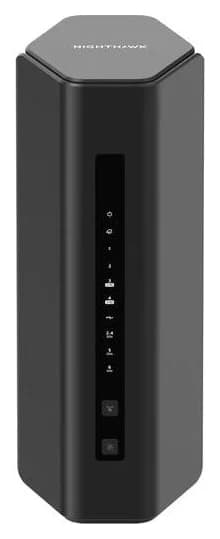
The RS100 and RS300 compared on bands, ports, coverage and price class: which Nighthawk fits your home size, service tier and expansion plans.
Comparison · Wi-Fi Routers
Starlink Ethernet Adapter vs. a New Router: Which Should You Buy First?
The first Starlink wired-networking purchase, in order: which router generation you have, whether the Ethernet Adapter or bypass mode applies, and when a Nighthawk RS300 earns its place.
Comparison · Wi-Fi Routers
Netgear Nighthawk RS300 vs RS700S: Which Wi-Fi 7 Router Should You Buy?
Netgear's mainstream and flagship Nighthawk Wi-Fi 7 routers compared by internet plan, wired ports, radios and coverage — so you buy the one your home needs.