

Comparison
UniFi UNAS vs Synology
Pick the NAS for Your Backup Job
Choose UniFi UNAS or Synology by your backup and recovery needs. Compare exact models, complete drive and network kits, applications, and offsite protection.
By thisPING EditorialUpdated November 3, 202610 min read
On this page · Quick picks
Choose the Synology DS925+ for most households that want computer backups, a photo library and NAS applications. Choose the UniFi UNAS Pro 4 for a file-sharing job in an existing rack, especially when you can use its 10G SFP+ connections. The Synology DS425+ is our lighter-duty Synology alternative; the complete configurations below compare the same backup job, not just empty enclosures. Also consider the UGREEN NASync DXP2800 for a smaller household storage and backup setup if two SATA bays meet your needs and its UGOS backup tools fit your recovery plan.
Quick picks
- Most households: DS925+. Choose it when supported backup and application packages matter more than a faster NAS uplink.
- Existing rack and a storage-first job: UNAS Pro 4. Choose it for shared files, Time Machine and the documented UniFi Drive backup destinations.
- Lighter Synology deployment: DS425+. Consider it when you do not need the DS925+'s ECC memory or memory expansion headroom.
- Also consider for a smaller setup: UGREEN NASync DXP2800. A two-bay, diskless NAS with a 2.5GbE port; check its UGOS backup and restore workflow before choosing it.
For a broader shortlist, start with best NAS for home. This comparison owns the UniFi storage decision; the separate Synology vs UGREEN guide covers that alternative.
UNAS vs Synology: the differences that change the purchase
These are the exact UNAS Pro 4 specifications and DS925+ specifications, with application and recovery documentation linked below.
Enclosure and SATA bays
- UniFi UNAS Pro 4
- 1U rack; four 2.5/3.5-inch bays
- Synology DS925+
- Four 3.5-inch HDD / 2.5-inch SSD bays
M.2 slots
- UniFi UNAS Pro 4
- Two, for NVMe SSD cache
- Synology DS925+
- Two, for compatible NVMe cache or storage pools
Network connections
- UniFi UNAS Pro 4
- Two 10G SFP+ slots, 10G only; one gigabit RJ45 port
- Synology DS925+
- Two 2.5GbE RJ45 ports
Processor and installed RAM
- UniFi UNAS Pro 4
- Quad-core ARM Cortex-A57, 2.0 GHz; 8 GB
- Synology DS925+
- AMD Ryzen V1500B; 4 GB DDR4 ECC, expandable to 32 GB
Software emphasis
- UniFi UNAS Pro 4
- UniFi OS and UniFi Drive; SMB/NFS, Time Machine, snapshots
- Synology DS925+
- DSM; Synology Photos, Container Manager, Active Backup for Business
Offsite route used here
- UniFi UNAS Pro 4
- UniFi Drive backup task to Backblaze B2
- Synology DS925+
- Hyper Backup to B2 through its S3-compatible interface
Documented recovery distinction
- UniFi UNAS Pro 4
- Console migration moves the original HDDs and restores configuration
- Synology DS925+
- Hyper Backup restores data from an existing repository, with its encryption key if enabled
Full comparison table
Swipe to compare. Row labels stay visible.
| Buying question | UniFi UNAS Pro 4 | Synology DS925+ |
|---|---|---|
| Enclosure and SATA bays | 1U rack; four 2.5/3.5-inch bays | Four 3.5-inch HDD / 2.5-inch SSD bays |
| M.2 slots | Two, for NVMe SSD cache | Two, for compatible NVMe cache or storage pools |
| Network connections | Two 10G SFP+ slots, 10G only; one gigabit RJ45 port | Two 2.5GbE RJ45 ports |
| Processor and installed RAM | Quad-core ARM Cortex-A57, 2.0 GHz; 8 GB | AMD Ryzen V1500B; 4 GB DDR4 ECC, expandable to 32 GB |
| Software emphasis | UniFi OS and UniFi Drive; SMB/NFS, Time Machine, snapshots | DSM; Synology Photos, Container Manager, Active Backup for Business |
| Offsite route used here | UniFi Drive backup task to Backblaze B2 | Hyper Backup to B2 through its S3-compatible interface |
| Documented recovery distinction | Console migration moves the original HDDs and restores configuration | Hyper Backup restores data from an existing repository, with its encryption key if enabled |
Scroll horizontally to see every column
| Buying question | UniFi UNAS Pro 4 | Synology DS925+ |
|---|---|---|
| Enclosure and SATA bays | 1U rack; four 2.5/3.5-inch bays | Four 3.5-inch HDD / 2.5-inch SSD bays |
| M.2 slots | Two, for NVMe SSD cache | Two, for compatible NVMe cache or storage pools |
| Network connections | Two 10G SFP+ slots, 10G only; one gigabit RJ45 port | Two 2.5GbE RJ45 ports |
| Processor and installed RAM | Quad-core ARM Cortex-A57, 2.0 GHz; 8 GB | AMD Ryzen V1500B; 4 GB DDR4 ECC, expandable to 32 GB |
| Software emphasis | UniFi OS and UniFi Drive; SMB/NFS, Time Machine, snapshots | DSM; Synology Photos, Container Manager, Active Backup for Business |
| Offsite route used here | UniFi Drive backup task to Backblaze B2 | Hyper Backup to B2 through its S3-compatible interface |
| Documented recovery distinction | Console migration moves the original HDDs and restores configuration | Hyper Backup restores data from an existing repository, with its encryption key if enabled |
The M.2 slots are not additional full-size HDD bays. Application support and drive fault tolerance also answer different questions: a matching bay count does not make the software interchangeable.
Best for most households: Synology DS925+
The DS925+ is our default when the NAS will do more than serve files. Synology's official package lists include it for Container Manager and Active Backup for Business; the model page also lists Synology Photos. Choose the packages you need before choosing disks.
The distinction from the similar DS925neo+ matters: the shared hardware table specifies 4 GB ECC memory for the DS925+ and 4 GB non-ECC for the neo model. The DS925+ supports up to 32 GB. This recommendation covers the ECC model, bought without a drive bundle.
Trade-off: its native networking tops out at 2.5GbE per port. Synology's Plus HDD marketing page advertises “Optional 10GbE expansion” beside a DS925+, but the NAS's own hardware table lists two 2.5GbE ports and no network expansion option. That conflict needs confirmation from Synology; we configure this model for 2.5GbE.
Best for an existing rack: UniFi UNAS Pro 4
The UNAS Pro 4 at Ubiquiti is the rack pick for a defined storage job. Its specification lists personal/shared drives, user groups, share links, snapshots, SMB/NFS and Time Machine, plus backups to another UNAS, an SMB server or supported cloud services.
Trade-offs: the RJ45 socket is gigabit; reaching the faster network requires an SFP+ connection. Its rails require a four-post rack with post depths of 600–1066 mm. Ubiquiti's RAID guide also limits the Pro 4 to one storage pool with one RAID group. Check those constraints before buying it for a desk or a complicated storage layout.
Which UNAS Pro variant?
- UNAS Pro 4: four SATA bays, two NVMe cache slots, two 10G-only SFP+ slots, 1U. This is the configuration recommended here.
- Original UNAS Pro: seven SATA bays, one SFP+ connection supporting 10G/1G, 2U. Its specification does not list the Pro 4's NVMe cache slots.
- UNAS Pro 8: eight SATA bays, two NVMe cache slots, two 10G-only SFP+ slots, 2U. It also adds native 10GbE RJ45, unlike the Pro 4; weigh that connection against the larger enclosure.
The original Pro and Pro 8 are unequal-bay alternatives to the Synology here. Extra bays are a capacity-planning advantage, not evidence of equivalent applications.
Also distinguish the desktop UNAS 4, with four bays and native 2.5GbE RJ45, from the rack-mounted Pro 4. The UNAS 2 is a two-bay desktop model with 2.5GbE. The rack configuration below specifically covers the Pro 4.
Alternative for lighter duties: Synology DS425+
The DS425+ retains four SATA bays and a 2.5GbE connection but starts with 2 GB non-ECC memory, expandable to 6 GB; its other network port is gigabit. Container Manager and Active Backup for Business list it as supported. Consider it for a restrained package list; choose the DS925+ when ECC and greater memory headroom are part of your requirements.
Also consider for a smaller household NAS: UGREEN NASync DXP2800
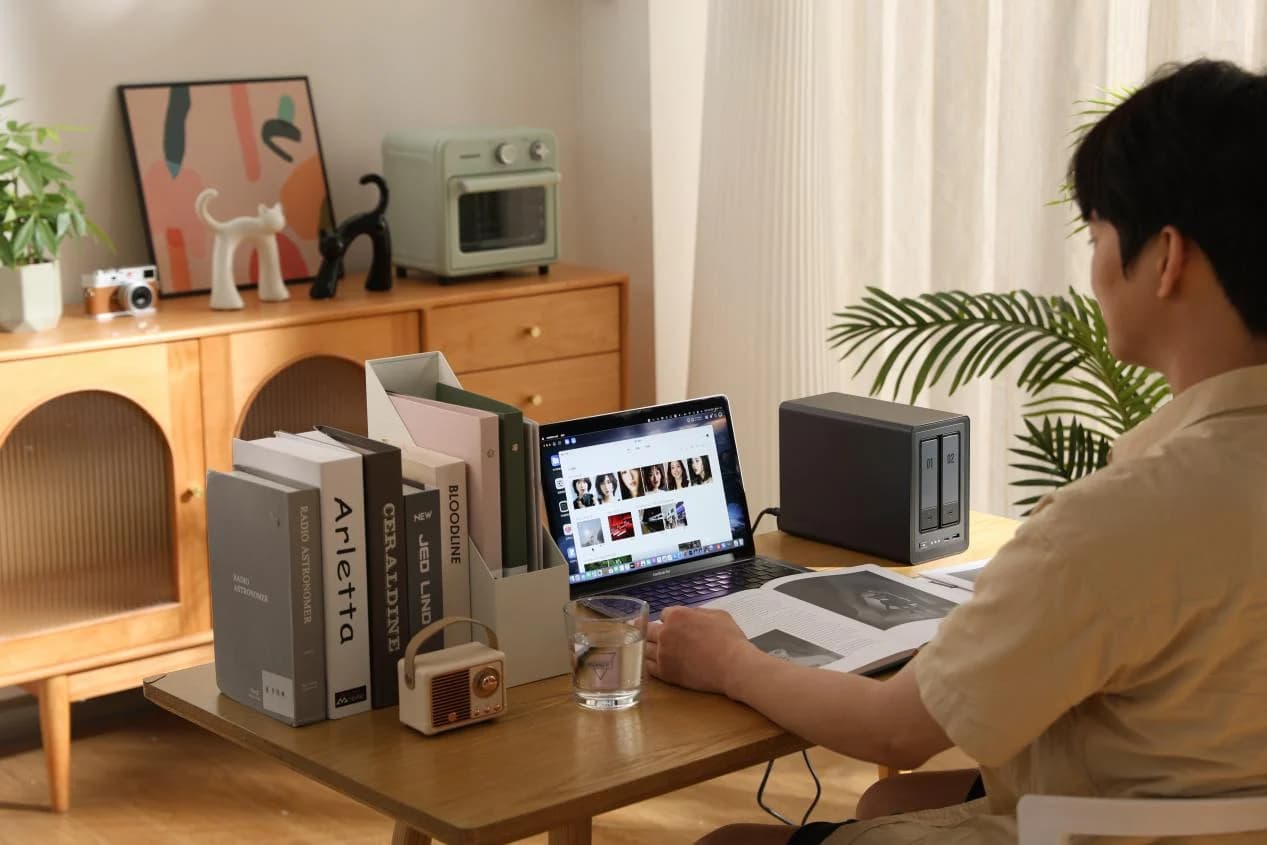
UGREEN
A two-bay NAS with an Intel N100, 8 GB DDR5, a 2.5GbE port, two M.2 NVMe slots and 4K HDMI output.
Check package and model options
- 2.5 Gbps port
- 2 bays
The UGREEN NASync DXP2800 is a diskless alternative with two SATA bays, an Intel N100, 8 GB DDR5 expandable to 16 GB, a 2.5GbE port and two M.2 NVMe slots for cache or a separate SSD pool. Consider it when a smaller household storage and backup setup meets your needs. Filling both SATA bays leaves no spare bay for later disks, unlike the four-bay reference enclosures below.
Trade-off: it runs UGOS. Confirm the backup, photo-management and offsite recovery workflows you need before ordering. The UniFi Drive and DSM instructions and drive kits below cover the compared models; choose a compatible drive set and recovery workflow for the UGREEN separately. For a closer look at that software decision, use our Synology vs UGREEN guide.
Complete configurations for the same household job
Reference job: Mac backups plus documents and photos whose originals remain on household computers. These are suggested configurations, not bundled products. Both start with two 16 TB HDDs and mirrored protection: 16 TB nominal protected capacity before system/filesystem overhead, with two SATA bays left empty. That is calculated from one drive's capacity, not a measured usable-space figure.
Enclosure
- UniFi configuration
- UNAS Pro 4; existing compatible rack required
- Synology configuration
- DS925+ diskless
Drive set
- UniFi configuration
- Two Ubiquiti UACC-HDD-E-16TB enterprise SATA HDDs
- Synology configuration
- Two Synology HAT3310-16T Plus SATA HDDs
Protection
- UniFi configuration
- Basic Protection; with two disks Ubiquiti uses RAID 1
- Synology configuration
- SHR with one-drive fault tolerance; two disks are mirrored
Common network
- UniFi configuration
- QNAP QSW-2104-2T-R2; Ubiquiti SFP+ copper adapter detailed below
- Synology configuration
- Same switch; connect a native 2.5GbE port
Independent destination
- UniFi configuration
- Backblaze B2 account and bucket for selected documents/photos
- Synology configuration
- Separate B2 bucket with Hyper Backup for those same folders
Full comparison table
Swipe to compare. Row labels stay visible.
| Part of the kit | UniFi configuration | Synology configuration |
|---|---|---|
| Enclosure | UNAS Pro 4; existing compatible rack required | DS925+ diskless |
| Drive set | Two Ubiquiti UACC-HDD-E-16TB enterprise SATA HDDs | Two Synology HAT3310-16T Plus SATA HDDs |
| Protection | Basic Protection; with two disks Ubiquiti uses RAID 1 | SHR with one-drive fault tolerance; two disks are mirrored |
| Common network | QNAP QSW-2104-2T-R2; Ubiquiti SFP+ copper adapter detailed below | Same switch; connect a native 2.5GbE port |
| Independent destination | Backblaze B2 account and bucket for selected documents/photos | Separate B2 bucket with Hyper Backup for those same folders |
Scroll horizontally to see every column
| Part of the kit | UniFi configuration | Synology configuration |
|---|---|---|
| Enclosure | UNAS Pro 4; existing compatible rack required | DS925+ diskless |
| Drive set | Two Ubiquiti UACC-HDD-E-16TB enterprise SATA HDDs | Two Synology HAT3310-16T Plus SATA HDDs |
| Protection | Basic Protection; with two disks Ubiquiti uses RAID 1 | SHR with one-drive fault tolerance; two disks are mirrored |
| Common network | QNAP QSW-2104-2T-R2; Ubiquiti SFP+ copper adapter detailed below | Same switch; connect a native 2.5GbE port |
| Independent destination | Backblaze B2 account and bucket for selected documents/photos | Separate B2 bucket with Hyper Backup for those same folders |
The Ubiquiti 16 TB drive is described as verified for UniFi device compatibility. Synology explicitly lists HAT3310-16T among the DS925+ compatible accessories; its Plus HDD table identifies the 16 TB model. These choices avoid assuming that any SATA drive has the same vendor support.
Third-party drives: Synology's DSM 7.3 announcement permits installation and storage-pool creation with third-party drives on 2025 DiskStation Plus models. M.2 pools and cache still require drives on its compatibility list. Recheck the exact model and installed DSM version; permission to install is not model certification. Our NAS hard-drive guide covers other disk choices.
Follow the whole network connection
These kits assume an existing router and a computer with a 2.5GbE port. The QSW-2104-2T-R2 has two 10G RJ45 ports and four 2.5G RJ45 ports.
For UNAS, fit the UACC-CM-RJ45-MG-US SFP+ copper adapter in a 10G slot, then connect it to a switch 10G port. For Synology, connect a NAS 2.5GbE port to a switch 2.5G port. Put the computer and existing router on separate remaining switch ports. Leave the unused NAS ports disconnected in these configurations.
Allow three appropriately sized Cat6A patch leads: NAS, computer and router. The existing Cable Matters 160012 family documents 10-Gigabit support; confirm the selected length and pack quantity. Both examples have a 2.5GbE computer-side link ceiling, not a guaranteed transfer rate. A gigabit computer instead makes that connection gigabit; the UNAS 10G label cannot upgrade its network port. See multi-gig switches before changing other network hardware.
Backup and restore: follow the files
UNAS: permissions, Time Machine and console replacement
Create a shared drive under UniFi Drive > All Files > New Shared Drive, assign users and optionally a storage limit. For Mac backups, Ubiquiti's Time Machine instructions enable SMB and Time Machine under Settings > Services > File Services, then create File Services & Time Machine credentials for the user. On the Mac, add the UNAS by device name and choose encrypted backup.
For an offsite copy, follow the B2 task instructions: create and securely save the application credentials, select Backblaze B2 in the Drive backup task and choose a bucket. Our reference cloud scope is ordinary documents/photos; it excludes the Time Machine repository. Ubiquiti warns that modifying files during backup can create conflicts, including when Time Machine is active.
Documented chassis recovery: Ubiquiti's migration procedure requires a replacement UNAS with at least as many bays. Save a System Config Backup; update the replacement to the latest GA version under the same account; factory-reset it and power it off. Move the original HDDs in the exact same order while powered off, then start setup and select Restore from Backup. This procedure depends on the original disks: a configuration backup alone does not replace lost file data.
For cloud file recovery, Backblaze documents Browse Files > select files > Download. Before relying on the UNAS task, retrieve an ordinary backed-up document that way, open it on a computer and copy it into a new NAS share. This is our acceptance check, not a claim of a vendor-documented full UNAS cloud restore. The fetched Ubiquiti cloud guide explains task creation, not that complete recovery procedure.
Synology: scoped access and repository recovery
Follow Synology's Time Machine setup: create a shared folder and user with read/write permission, set a quota, and advertise the selected Time Machine folder through SMB/Bonjour. Give household users access only to the folders they need.
Backblaze's Hyper Backup integration uses S3 Storage > Custom Server URL, the bucket's S3 endpoint and application credentials. Select the same documents/photos as the UNAS example, set a schedule and review retention. Keep credentials and any backup-encryption key separately from the NAS.
Documented data recovery: in Hyper Backup choose Restore > Data > Restore from existing repositories, select the destination, then choose the configuration/data versions required by the wizard. An encrypted task requires its password or encryption key. Synology's restoration instructions explicitly cover external repositories. Reopen a recovered document before treating the job as complete.
Keep the originals
Retain the source documents and photos on household computers.
Create the NAS backup
Configure permissions, Mac backup access and a separate shared-file copy.
Recover the independent copy
Run the selected cloud task, retrieve a document and verify that it opens.
How we choose
We compared official hardware tables, package compatibility lists and backup/restore instructions fetched on November 2, 2026. Capacity examples are calculations; port rates are interface specifications. We have no measured throughput, reliability or noise results for these configurations. We prioritize a supported application and recovery path over processor labels. See how we choose.
Buying guide: administration before accessories
- Yes: Write down the exact enclosure and disk models before ordering.
- Yes: Assign someone to review failed backup jobs, storage alerts, updates and recovery credentials.
- Partly: Add NVMe cache only after identifying a workload that needs it; neither reference kit requires it.
- No: Do not count a mirror or a snapshot on the NAS as the independent copy.
Ubiquiti says snapshots must be enabled and consume space as files change. Its storage-pool guide warns that losing an encryption key permanently loses access to that pool. Keep recovery information outside the storage it unlocks. Follow supported software updates rather than treating a model name as a promise of future support.
Verdict
Buy the DS925+ when backup applications, Photos or containers are part of the job. Buy the UNAS Pro 4 when its documented file services fit an existing rack and you have accounted for the SFP+ connection. Consider DS425+ for lighter Synology duties. Also consider the UGREEN NASync DXP2800 if two SATA bays are enough and you have checked that its UGOS backup and restore workflow meets your needs. Choose the complete drive, network and recovery configuration before ordering the enclosure.
Frequently asked questions
What is UNAS, and which model should I compare with Synology?
UNAS is Ubiquiti's network storage family. This guide compares the four-bay UNAS Pro 4 with the four-bay Synology DS925+. The original UNAS Pro has seven bays, while the UNAS Pro 8 has eight. Those rack models are different enclosures, so match the complete model name, drive count and network connections before comparing configurations.
Can a Synology DS925+ use WD or Seagate hard drives?
Synology's DSM 7.3 policy permits installation and storage pool creation with third-party drives on 2025 DiskStation Plus models. That permission does not certify every model or firmware revision. Check the current compatibility list before ordering; M.2 storage pools and cache still require listed drives. Our reference kit uses a Synology-listed SATA model to keep that choice straightforward.
Can UNAS replace Synology for containers and a photo library?
Choose Synology if those applications are central to the purchase. Synology lists the DS925+ for Container Manager and Active Backup for Business, and its product specifications include Synology Photos. Ubiquiti documents UNAS file services, Time Machine, snapshots and backup destinations. Those capabilities do not establish equivalent application support; buy UNAS for the documented storage job rather than assuming package parity.
Is a mirrored NAS enough backup protection?
No. Mirroring provides drive fault tolerance, and Synology explicitly says RAID is not a backup solution. Keep the originals, a NAS backup and an independent destination. Both reference kits here use Backblaze B2 for selected documents and photos. Keep that scope explicit: the suggested cloud task is not a promise of a complete computer or NAS system restore.
Related guides
Comparison · NAS
UGREEN DH4300 Plus vs DXP4800 Plus: Which Four-Bay NAS Should You Buy?
UGREEN DH4300 Plus vs DXP4800 Plus: compare apps, RAM, networking and the same drive basket, with usable capacity, backup and exact-model buying checks.
Comparison · NAS
UGREEN DXP6800 Pro vs DXP8800 Plus: Buy Six Bays or Eight?
Choose the right UGREEN NAS with equal-capacity drive plans, RAID expansion limits, exact US model checks, network advice, and a separate backup shopping list.
Best picks · NAS
Best All-Flash NVMe NAS: Choose the Enclosure, SSDs and Network Kit
Choose an all-flash NVMe NAS with compatible SSDs, realistic network limits, usable RAID capacity and a separate backup plan. Compare F8 SSD Plus and Flashstor.